
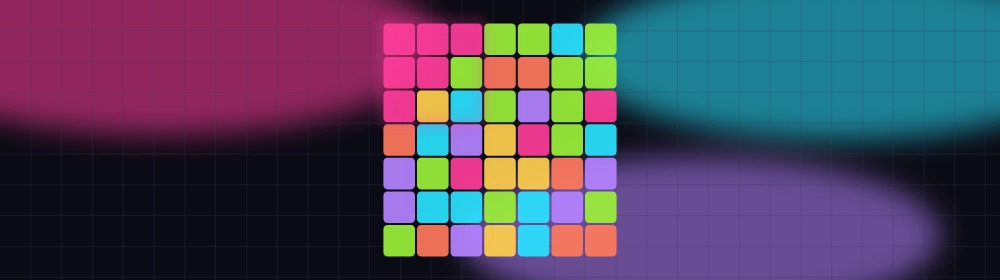
 Fill the board in few moves
Flood
Flood the grid from the corner until it becomes a single color, in as few moves as possible.
One puzzle a day, the same for everyone
The day's grid, 14 × 14 in six colors, is drawn from the date. A solver computes an achievable target move count.
- The same grid for everyone, until midnight in your device's local time.
- The target is an achievable move count, computed by a solver.
- The shared result is your move count, never the series of colors.
- Completing a challenge — any of the four — extends your streak by one day.
The Free play / Daily challenge toggle sits at the very top of the board. The challenge never touches your free-play best scores, and free play stays unlimited.
Five steps to your first win
- Look at the corner.The top-left cell and its same-colored neighbors form your starting region.
- Pick a color.The region takes that color and swallows the neighboring cells that already had it.
- Grow the region.With every move, it spreads. The goal: cover the whole grid.
- Use the symbols.Each color carries a symbol (▲ ● ■ ◆ ★ ✚), so you never depend on color alone.
- Stay under the target.The number shown is achievable. Beating it means thinking two moves ahead.
What you need to understand
One input for every way to play
Mouse and trackpad
Click a color in the palette to flood. The current color is disabled: playing it again would do nothing.
Touchscreen
The six color swatches stay large and spaced out, each with its own symbol.
Keyboard
Tab moves from swatch to swatch; Enter or the space bar floods. The corner region and its size are announced after every move.
Five things you won't guess on your own
- Look at which color borders your region the most: choosing it swallows the most cells in one move.
- Thinking two moves ahead almost always beats the reflex: sometimes a small gain now opens up a big one next turn.
- The target comes from a greedy solver — on every move it picks the color that grows the region the most. It is achievable, not necessarily optimal.
- Every color carries a symbol in every cell: the grid can be read without depending on color.
- Replaying the color you already have does nothing, so the game disables that swatch: you can't waste a move that way.
Flood, in detail
You start from the top-left corner cell and every same-colored cell touching it: that is your region. Choosing a color repaints the whole region, which then absorbs the neighboring cells of that color. The goal is for the entire grid to become a single color.
Yes. A finite grid of colors can always be reduced to a single color in a finite number of moves. We also check that a solver gets there before showing you the grid.
It is an achievable move count, computed by a greedy solver that picks, on every move, the color that grows the region the most. It is achievable, but not necessarily the absolute minimum: beating it is possible, and that's the real challenge.
Your region's current color is disabled: playing it again would change nothing and waste a move. The game stops you from doing that.
Every cell carries a symbol based on its color (▲ ● ■ ◆ ★ ✚), and so does every swatch in the palette. The corner region and its size are announced after every move.
It is your lowest number of moves to unify the grid, saved per size.
The day's 14 × 14 grid, in six colors, is drawn from the date: the same for everyone. The shared result is your move count, never the series of colors you played.
It's the same fill puzzle. Flood-It is a registered trademark of LabPixies (Google), with whom we have no affiliation. Our game is called Flood and the solver is our own.
Keep exploring the site
All four games play right on the page, with no account and no download.